
playing
 You Can’t Love What You Don’t See: The Missing Pieces of ‘Fallout 3’
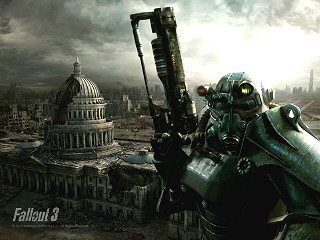
Fallout 3 should have been my favorite game of the year. The post-war wasteland provides an amazing setting, and it’s rendered with attention to every burned-out, abandoned detail. Each quest delivers a unique story, touching on all manner of people trying to carve out some kind of life in the desolation. Fallout‘s version of Washington DC an immense, complex, and imaginative universe, with countless interesting things to do and see; taken as a whole, it ranks among the best-realized game worlds out there. Scores of reviewers and players have already professed their love for Fallout, making it a must-try at the very least. Objectively, it has everything going for it, and on paper there’s a good case for calling it the best game of 2008.
If I was a slightly different person, it would have been. But for all the impressive things built into this game, what’s left out prevents it from being as satisfying as its potential.
……….
The best thing about Fallout is discovering the bizarre ways each remaining pocket of humanity has dealt with the end of the world. I’d hate to spoil anyone’s surprise, but without getting into specifics, I met a cult of cannibals, battled giant ants, and tried to reason with a robot who thought he was a founding father. When I stumbled into Tranquility Lane, my jaw dropped — spoiling that moment would be criminal — and at times like those I thought, “This is a spectacular game”. Instead of carefully crafting a blockbuster from beginning to end, the team at Bethesda designed a world in which every seemingly innocent errand uncovers a fascinating story all its own. Fallout does things that are truly unique among the games in my library, and for that they deserve the level of acclaim they’ve received.
The unfortunate side effect of setting your game in a wasteland, however, is that wastelands are both sprawling and uninviting. Traveling to new places across the barren expanse is dull, dreary, and dangerous until you stumble upon those chestnuts of story. Normally, walking those long distances toward a destination is not a problem, because you’re doing it with purpose. But seeing something in the distance, slogging several uneventful minutes to get there while having occasionally fatal encounters with local fauna, only to find an abandoned power station with a few treasure chests? This does not encourage further treks into the unknown. So my approach shifted. I started only going places when other characters or events gave me a legitimate reason for my trouble.
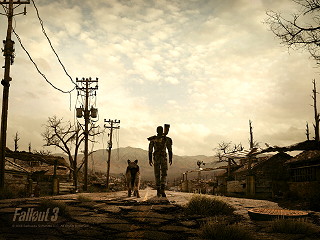 This is where the construction of the game battles itself to a degree. In an open world dotted with trigger points, a well-made game shouldn’t merely rely on an assumption that as a gamer I will scour every inch in order to find all the morsels and ‘complete the game’. The designers share the responsibility to motivate me to explore. Especially when you’re facing a hostile world, the human, emotional reasons to traverse the game space make all the difference — a pretty girl asked you for a favor; a scared child needed your help; a likable guy with a good sense of humor hopes a friendly stranger will give him a hand. The scenes that do play out this way feel so organic, they reward you for your actions not just with fame and fortune, but a sense of being part of a living world.
So in the instances the system ran flawlessly, I did start to love Fallout. But as I approached the end of the game, I realized there were huge chunks of the map no one had ever pointed me toward, and I’d been so happily involved with the quests I did get that the game was over before I knew it. An ending which, for all the strange, twisting stories that play out during the game, was so abrupt and anti-climactic that it made me wonder if I had done something wrong, and tainted the whole rest of my experience. Not only that, but once it’s done it’s done; there’s no going back to explore and find out what you may have missed — a huge strike against the basic premise of an open, living world.
……….
The argument might be that it’s meant to be played more than once, but to be honest that’s unfair to the player, and me specifically as an adult with a normal life. Going through once took me a month as it is. It’s presumptuous of a studio to ask me to dedicate another month to see the rest of their creation, with so many other games out there to play, much less the other demands on my time besides playing games. It’s equally unfair to the people who labored over the great moments I never got to see. Doing a little reading after the fact, I found out that I actually missed out on some of the coolest things in Fallout 3. There was a town with dueling super-heroes? Vaults filled with clones and insane hallucinogenic drug users? A cult of people who worship a living tree-person? I wanted to play those parts too. But either through bugs in the system or just neglecting to talk to the one person who would have pointed me in those directions, I didn’t see any of them.
Had they built in more interlocking pieces that point players toward the stories they crafted to fill this world, I wouldn’t have finished the game feeling like I’d only played half of it. Or an even simpler fix would have worked, if at some point earlier in the game they orchestrated a run-in with a cartographer character who provided a map with points of interest. Either way, I would have known where to find these narrative treasures. But at no point did I get a real sense of where the rest of the game was, and that’s what’s missing from Fallout that kept me from fully loving it. It’s a sad waste of compelling game content, and could have been avoided with just a few more bread crumbs along the way.
……….
In no other medium is it possible to technically consume an entertainment product from beginning to end, and yet miss out on large chunks of its experience. You don’t have the option of seeing Hamlet without the encounter with the gravedigger and the unearthing of Yorick’s skull. There’s no version of the Godfather where Michael doesn’t go to Cuba and decide to have his own brother killed. Part of the growing up of games as a medium will be figuring out how to allow freedom for the player, but not at the expense of entire chapters of the stories their creators are telling.
So while some critics absolutely adored Fallout 3, some have hesitantly admitted they weren’t so crazy about it. The dividing line could be attributable not to whether it was a good game or not, because there should be no question that it’s a fantastic achievement. In the end, it really comes down to playing style. If you’re inherently motivated to see everything there is to see in the world of Fallout, you probably can’t help but be bowled over by all it has to offer. But if, like me, you need a little prodding from within the game to unearth its pleasures, you may not even realize what you were missing until it was too late. Then you may be embarrassed to admit that the supposed game of the year was only ‘pretty good’, not as amazing as everyone seems to be saying. If you feel that way, don’t feel guilty — it’s not your fault. The pieces were there, they just left out some of the connective tissue. Maybe we can all revisit it later and catch up on what we missed. If you have yet to play this game you really should, because it’s one of the best out there. One suggestion though: be thorough, or you might only end up playing half of a masterpiece.
Leave a commentside notes
 An Animated ‘9’, Documentary on Design, and Mash-ups Online
2009 is looking to be a good year for animated films. Sure, there will be another high-quality Pixar release, but that’s almost expected at this point. There’s also the Neil Gaiman-via-Henry Selick adaptation of Coraline coming in the spring, which we’ve mentioned before, that’s looking as gorgeous as you would expect (and has an elaborate website full of all kinds of stop-animated bonus goodies). If you’ve been paying attention, you may have just heard about the dark horse Waltz With Bashir from Israel gobbling up awards and playing now in select cities, that looks to be Persepolis minus the whimsy, plus a lot more war.
Now, the trailer for a movie called 9 puts another mark on this year’s powerhouse animation line-up.
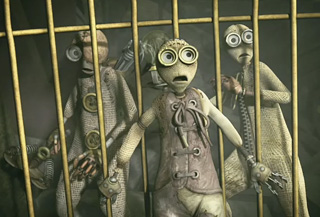
Props to Focus Features for picking up both Coraline and this for the same year; it’s like hitting bingo for things supported by Under Culture. Writer/Director Shane Acker expands his original 11-minute, no-dialogue, Academy Award-nominated short film, about a colony of rag dolls fighting evil robots in a post-apocalypse (one), into a full feature. I originally saw the short a couple years back when it was one of the highlights of that year’s Animation Show (two), and the world he painted can definitely support a deeper story. The trailer looks fantastic, especially in HD, and includes a song you may recognize as Coheed & Cambria’s ‘Welcome Home’ from Rock Band (free space). The film gets production help from Tim Burton (four), and voice talent including the likes of Elijah Wood — okay, whatever — but Jennifer Connelly, John C Reilly, Martin Landau, and Crispin Glover (BINGO!).
This one looks pretty promising. And even more badass if, like me, you’ve been playing Little Big Planet recently and glad to see little burlap dudes are also capable of kicking some ass.
I remember Acker coming out for the Q&A portion and describing how excited he was about the film project, seeming very genuine and oh-man-I-can’t-believe-it-either about the chance to work with such great talent. If the trailer isn’t enough, you can find the original short with a simple web search before this one pops up on, what else, 9/9/09.
(When, coincidentally, there might also be another film starring Daniel Day Lewis, called Nine, releasing the same day — according to, well, io9 of all places. Careful your head doesn’t explode…*coughNINEcough*. There, now for feng shui purposes I’ve said it a full nine times in one post.)
……….
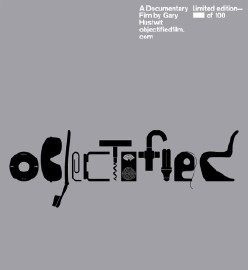 For the design nerds out there, another sweet documentary is headed your way from the exciting talents that brought you Helvetica, a movie about fonts. No, not Helvetica Neue: Font Harder or Times New Roman: Cruise Control.
This one’s called Objectified, and it’s about industrial design (oooo!).
Helvetica is still lingering in my Netflix queue, but both of these films tackle wonderfully dull-sounding vocations that are actually extremely deep and elegant in practice. The kind of thing you would flip to on PBS and find yourself riveted by, and possibly change the way you look at the seemingly mundane objects all around you. I can’t wait to see these films.
And as it turns out, they’re airing Helvetica this month for PBS’s Independent Lens series, so check your local listings for some hot typeface action.
……….
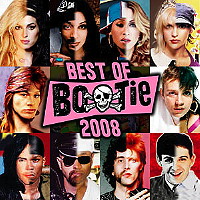 Finally, who can say no to free music? Especially when it’s funky mash-ups of dance tunes perfect to raise eyebrows at your next party, from the world’s premiere bootleg enthusiasts of Club Bootie.
Right now you can download their Best of Bootie 2008 cd, plus another dozen bonus tracks.
Having recently attended their LA club night, I must profess some love for what these people are doing. It’s a great fun way to dance the night away. Everyone knows the mash-up thing is not as trendy as it was a few years back, but come on, tell me you don’t have more fun on the floor when it’s songs you know the words to with an extra shot of groove. It’s okay to stop pretending.
Not every track on here is a certified winner, but there are a couple home runs, like the MIA/Wreckx N Effect – Paper Planes/Rump Shaker track, and the Justice/Jackson 5 – D.A.N.C.E./I Want You Back mix we all knew was coming. Go listen for yourself and start building that next party playlist.
1 commentside notes
 Our Favorite Shit: 2008
Admit it. Half the time when making a top ten list for the year, by the seventh or eighth slot you’re starting to get generous. That one wasn’t perfect but it was good enough; you didn’t enjoy this one all that much but you’re kind of expected to have it on any respectable list. We all know it happens.
So at Under Culture we nixed the top tens, top fives, top eights of ’08 or what have you. Instead, we sat down for an epic virtual discussion of our absolute favorite things of the year, in every category we could think of, and set about explaining why each one made the list. This way you know everything that shows up here really deserves it, and if we missed your favorite it’s either that our panel of two hasn’t gotten to it yet, or you are just wrong.
And if one were tempted to give a cute shorthand name to these awards, that name might be The Undies — some puns are just too terrible to resist. So without further ado, here is all our favorite shit of 2008.
WATCHING
Best Movie
Brian: It’s kind of ridiculous for me to answer this question. Did you think I’d pick fucking Wall-E? (okay, it was a close second). But of course I have to go with The Dark Knight. Batman is the best hero of all time, The Joker is the super-est of all super-villains, and this movie had me from its incredible opening scene to its final moral dilemma. What other movie from this year will you watch over and over besides this one?
Spencer: Definitely right on Dark Knight; I watched it for a second time the other night and enjoyed it more than when I saw it in the theaters. For me, the best movie of this year was one that came out last year: There Will Be Blood, which I saw in January. I’ve got to admit that I’ve been more neglectful than usual and haven’t taken advantage of living in L.A. and seeing everything I could, but for me so far, the best movie of 2008 was Milk. Great cast, great performances, great tribute.
Best Worst Movie
Brian: Going to see an over-the-top, piece-of-crap movie can be risky, in that sometimes it’s not so bad it’s funny, it’s just disappointing (I’m looking at you, Wanted). Let me tell you, Rambo was not such a case. One scene was almost too violent for me to watch, involving a bit more civilian-killing than I was ready for, but it did set up an awesomely absurd final act of sweet, sweet Stallone nonsense.
Spencer: Whoops, I thought Rambo was legitimately good. For my Best Worst Movie that is actually somewhat decent, I’m going to have to go with Teeth. For those who haven’t laughed their way through it yet, it’s a movie about a girl who is somewhat improbably being constantly sexually assaulted, and then discovers that her vagina has teeth and can rip off dudes’ equipment. And however reading that premise makes you feel is exactly how you will feel about the final result. Best Worst Movie without any redeeming qualities is Aliens vs. Predator 2: Requiem.
Best Netflix Rental
Brian: Out of the 42 discs that have passed through my hands this year (a decent take, but paltry compared to some *ahem*), very rarely was I full-on surprised and delighted. A few of the times I was have ended up in other slots on this list, but the one that stands out the most is Paprika, the only one I wanted to own after watching the first time. Satoshi Kon’s Alice in Wonderland meets Blade Runner visual rollercoaster of anime just blew me away.
Spencer: I estimate I got about 640 discs from Netflix, if that’s what you’re referring to, Brian. And I’m going to come out of left-field with the best one I rented. It’s the 3-part Benjamin Franklin documentary that aired on PBS in 2002, directed by Ellen Hovde and Muffie Meyer. It basically turns you into Homer in the episode of The Simpsons where all he can talk about is Thomas Edison, except for Benjamin Franklin.
Best Documentary
Brian: Some people don’t do fiction because they say real life is way more interesting. You couldn’t ask for a better example on film than The King of Kong. It has highs, lows, heroes, villains, laughs and tears — don’t tell me you didn’t well up at the end too. I had no idea old-school arcade cabinets could provide the backdrop for such a great movie.
Spencer: Brian, normally we’re on the same page, but while King of Kong was certainly awesome, there were so many amazing documentaries this year on weightier subjects than a 25 year old arcade game and the desperate geeks still competing on it. I’m going to have to give this Undie to Errol Morris’ Standard Operating Procedure, which, for how amazing it is now, will probably serve even better as a historical document. The most ironic part to me is the uproar in some circles over Morris paying people like Lynndie England for their interviews; these same circles tended to have no problem with the US military paying random foreign citizens bounties for turning over a lot of innocent people that ended up getting tortured in places like Abu Ghraib.
Best Animated/Anime Movie or Show I Saw This Year
Brian: Coming off the heels of my discovery of Satoshi Kon with Paprika, I started looking for more of his work and turned up his 13-part series Paranoia Agent. I’m comfortable with the term ‘masterpiece’ for Wall-E, but at the end of the day that’s a wholesome kids movie. This is a complex, adult story told from many points of view. It uses a mix of animation styles to convey different meanings. It’s sometimes funny, sad, violent or touching. It does for animation what Twin Peaks did for TV.
Spencer: I can’t be ecstatic about Wall-E after how big a decline in quality it was from Ratatouille. I love old school animation, and am going to give this one to the Chuck Jones Collection DVD I rented from Netflix. It’s a compilation of his non-Looney Toons stuff, like Rudyard Kipling stories and other classic animation bits he did.
Brian: I think you might be the only person I know who’d pick the cooking rat over the adorable robot, but goddamn, I respect you anyway.
Funniest Show on TV This Year
Brian: This could be my crush talking (either on Tina Fey or Alec Baldwin, I’m not really sure anymore), but I think I laughed more at 30 Rock than any other sitcom. A lot of the time it’s silly, but here and there are brilliantly written throwaway lines that are like hidden treasures. I love a show that’s willing to hide bonus jokes, not just go for the big obvious ones (we miss you, Arrested Development).
Spencer: No Curb Your Enthusiasm this year? Then I think it defaults to 30 Rock, like you said. An honorable mention to How I Met Your Mother, which I think is consistently underrated due to being designed for and funniest to people within a five-year range of ages that happens to be exactly where we are right now.
Best Series on TV This Year
Spencer: The Wire concluded its run, and I left the DVD’s sitting there until October because I didn’t want it to end. But end it did, with creator David Simon releasing all his frustration towards the newspaper industry, specifically his old home, the Baltimore Sun. Throw the other parade of sociological issues into the mix, and the results were spectacular. TV’s been good the last few years, but The Wire stood head and shoulders above the rest.
Brian: Damn, that was this year? I’d already mourned its passing so fully that seemed like forever ago. And no, I can’t disagree with you. As far as ongoing series, one would hope HBO would have filled the gaps left by its Wires, Deadwoods and Sopranos and taken down this prize with something new, but no, the top slot for this year goes easily to Mad Men. Nothing else on TV is this sophisticated, subtle, and well-developed in plot and character. I almost cried when the final episode aired and I had to start waiting for next season. Honorable mention to Veronica Mars, the best show I missed the first time around and finally caught up on.
Spencer: Don’t feel guilty about Veronica Mars. The thing about it was, how the hell was anybody going to find it? It was on Channel 13, took place at a high school (the first two seasons), and superficially looked so indistinguishable from a million terrible TV shows that you’d never know how great it was unless someone told you personally about it and then possibly supervised you to ensure you watched it. I predict it will be rediscovered at some point down the line and enjoy a critical revival a la Twin Peaks.
Keep reading for Best Video Game, Best Book, Best Album That Isn’t On Any Other Best Of Lists, and more…
3 commentsside notes
 A Lifeless ‘Spirit’, a Pointless ‘Dante’s Inferno’, a Peerless Gaming Panel, and Soulless Best Of Lists
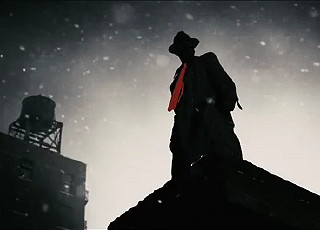
It’s safe to say that Under Culture is pro-Frank Miller. Personally, the Dark Knight comics rank among my favorites. The influence of his take on Batman is apparent in the excellent reboot of the last two films. The Sin City books are just packed with gritty, pulpy fun, and the movie did a great job of bringing that sense of comic noir to the screen. Even 300, though obviously over the top, was at the very least one long, macho fight scene that was fun to watch. So he’s done some great stuff, and the translations of his work to film have been genuinely entertaining. I’m not that familiar with the source material of his latest project, The Spirit, but I liked the look of it and was willing to take the chance on another Miller film.
Then I watched some clips from The Spirit posted over on io9 and decided there is no way I’m paying to see this movie.
“But it’s just some good cheesy fun!” one might protest. Agreed. And I’m usually all for that. But as a fan who loves movies like The Rocketeer, Dick Tracy, even Sky Captain and the World of Tomorrow, there’s a glaring difference between those fun trips to a stylized retro-future and the one in these Spirit clips: sincerity. The others work because as objectively silly as their worlds may seem, the characters were all invested in their reality. Whether due to Miller’s inexperienced directing or a mistranslation of comic to script-writing skills, each of these scenes feels like its being acted out — like no one in the movie is convinced of what they’re saying in the slightest. Once the seams start showing the whole enterprise just feels goofy, even dumb. So I’m sorry Frank, but I’m probably going to choose Benjamin Button over your first directing gig for a Christmas weekend flick. Don’t worry, we still love ya’.
[Of note though is that the only likeable one of these six clips is Scarlett Johansson’s. That girl can actually act. This scene especially makes me want to see her in a role where she gets to be sassy and funny instead of getting continuously typecast as serious and sultry.]
……….
In other awkward adaptation news, a trailer was revealed this week for Dante’s Inferno…the video game. Yes, that Dante.
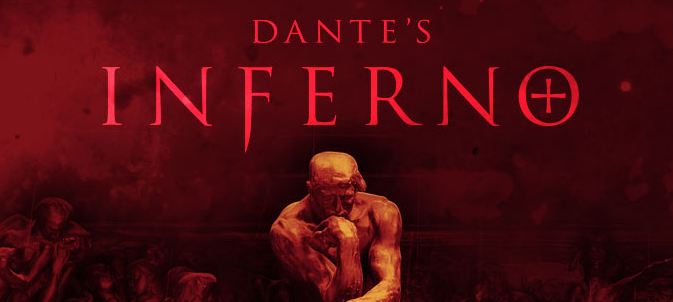 From the paltry footage contained in the clip, you seem to play as some sort of Christian warrior battling the demons of hell. The choice seems misguided at best. Sure, Dante’s depiction of hell would make a pretty great, gruesome setting for a video game — it even has a built-in structure of nine levels. But as anyone who’s read the source knows, the main character is essentially a tourist, just passing through and in no way affecting, much less getting into bloody battles with, the souls trapped there. If you play as some other traveler, why reference the book for your game’s title? No one’s clamoring to finally see their favorite 14th century epic poem brought to life that I know of. Also, God of War has already taken us to a mythical hell in some pretty cool ways, and it’s doubtful this will be wildly better for using Christian instead of Greek themes. Unless of course there’s a sweet party system that lets you team up with a Holy Spirit-summoning Jesus and a force of nature-controlling Moses, and you call it Final Divine Fantasy Inferno XIII. I might play that one.
……….
One of my favorite Year in Gaming pieces, the now 2nd annual Slate Gaming Club, wrapped up recently, and made for some thoughtful reading.
 The mile-high view of the year versus a sterile top-ten list offers a lot more to ponder, with a great back-and-forth exchange between four insightful critics from Slate, NY Times, Newsweek and MTV. They start out discussing why 2008 is or isn’t the best year yet in gaming (maybe not?), and move on to what would have put it over the edge.
The theme seems to be that everyone got really into one game, but that wasn’t the same for everyone and individual responses may vary. Moderator Chris Sullentrop reacts:
One thing I’ve been wondering: Is it a good sign or a bad sign for the medium that this year’s crop of games has produced such a wide divergence of opinion? Michael “the Brainy Gamer” Abbott thinks Fable 2 is perhaps “the most seductive game world ever created.” Chris Dahlen thinks Fallout 3 “balances—and sometimes betters—the approaches of other videogame masterpieces: the retro immersion of ‘BioShock,’ the paranoia of ‘Portal,’ the exploration of ‘Oblivion’ and the seamless storytelling of ‘Half-Life 2.’ ” The pseudonymous “Iroquois Pliskin” says GTA IV is “a classic, and stands head and shoulders above its previous iterations and nearly every other game released this year.”
Those are three more of the smartest people writing about games. They each think their Game of the Year is a new addition to the canon. Maybe they’re right. Or, more likely, this was a year of just-misses, which is why there’s an absence of consensus.
I’m with him in thinking it could have been, but that all the marquee titles, of those I’ve played so far, were just a bit flawed or fell short in some way that didn’t quite reach revolutionary status. Of course, if I had a PS3 and had played MGS 4 and Little Big Planet, maybe I’d feel differently? I know I’d have a hard time giving a top prize to Fallout 3 after getting to its let-down ending this weekend. As someone with a limited time budget for games, I know most years there are a legitimate top three I have to play, and fill in the rest of the year with whatever sounds fun. This year, it wasn’t as obvious which were those three.
……….
And a final note on the season of Best Of lists from an old favorite, Ryan at Catbirdseat, which sums up my thoughts pretty well:
And what struck me about that is that it rings of exactly what I think a Top/Best/Favorite list should be. It should be the music that, for whatever reason, just really resonated with the listmaker. The music that became part of their lives, instead of part of their “collection.” I realize that makes the lists WHOLLY idiosyncratic and subjective… but I feel like that’s the whole point. Music ain’t science, it ain’t statistics. It’s lust, and heartbreak, and anxiety, and confusion. It’s Elvis’ hips, and Joe Strummer’s guitar. It’s the too-short life of Ian Curtis.
It seems like at some point in the past few years, we decided that it was more important to value music against some nebulous set of criteria that we can apply numerical values to. Let’s keep it up and maybe one day, we can finally squeeze ALL the fun out of this.
Applies nicely not just to music but to everything we love. And also squares well with the Under Culture 2008 wrap-up, coming next week, which is not lists at all but an epic dialogue between Spencer and I on all of our favorite things this year and what made them stick with us. Look forward to that shortly after the holiday break and have a lovely winter celebration, friends.
1 commentplaying
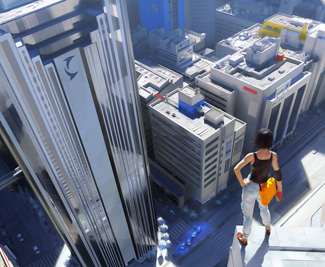 Don’t Walk the Line: Running Down ‘Mirror’s Edge’
Games can be satisfying in several different ways. Sometimes it’s immersive storytelling, being taken on a journey. Grand, exciting, surprising games, the best of which make up my all-time favorites like Bioshock or Shadow of the Colossus. Sometimes it’s more of a Die Hard impulse, more of a roller coaster than an epic, and I just like some fucking explosions. Gears of War, Call of Duty, Resident Evil, or God of War all stimulate the part of my brain that craves pure thrills. A lot of games fall under that column, so they’re easier to come by and therefore the sort I’ve played the most of. Some tread a space between the two (GTA 4), some live outside convention and carve out new spaces (Braid, Rez), some are just a fun simple challenge to wrap your brain around for a bit (the puzzle/arcade genre).
But modern consoles have also enabled games whose appeal could be called concrete, in that they make it possible for ordinary people to do things via controller they’d have to train a lifetime for in real life. At a certain point sports and racing sims entered this realm, as they grew to demand a real understanding of and command over the mechanics involved. For people who love the NFL or sports cars, but would never get to coach the Cowboys or drive an Aston Martin, these are ideal. By introducing a plastic instrument, Guitar Hero did this with performing music; by using the joysticks to control your board in a new way, Skate delivered a much more concrete experience than Tony Hawk‘s super-extreme combo-building. The goal of these games is a mastery of skills more than a progression from beginning to end. Any story serves as a framework around which to provide greater challenges to hone your talent. Particularly in the last two examples, there’s a specific chain of events laid out before you, and the satisfaction is in training yourself to finally nail it. Even better is when you’ve mastered the principles to the point where you can nail something the first time through, and feel like you’ve really become a top notch rocker, skater, driver, etc.
That’s basically a long way of getting to both the best and most annoying part of Mirror’s Edge at the same time — the reason everyone should absolutely try it, and some will also find it maddening. It’s a concrete realization of something truly thrilling, unlike anything you’ve ever played, with a few hitches that can make or break your time with the game.
……….
If you have yet to play Mirror’s Edge, it’s a game of what the French call parkour, the art of movement. To the rest of us, that means running really fast and jumping over, across, and off of things in seemingly impossible ways. Hyper-modern rooftops, tunnels, hallways, warehouses, and other sparse spaces make up the levels through which you move as quickly and efficiently as possible. The kicker is that you do it all in first person, meaning the sense of motion and space comes straight to your eyeballs, not by watching where your character lines up with each obstacle. Once you learn the basic controls and start to get a sense of how to move through the world, you vault, slide, leap, tumble and sprint through your urban playground, allowing you to cover huge distances and scale up or drop down from enormous heights at top speed. Getting into a flow of fluid motion leads to some of the most exhilarating gaming moments in any game this year.
However, it does take some practice to be able to do this gracefully, and that becomes the deciding factor in how much you’ll love or hate this game. At first, red-tinted objects guide your path as you work out the right timing for each jump. In the early levels, these are more frequent and obvious in pointing out the proper steps to follow. The frustration comes later, not because it’s hard to learn what you’re supposed to do, but because it’s not always as easy to learn how to do it just right.
It’s here where your mileage may vary. If by the time you get to tougher levels you’ve had one of those sublime stretches, where you’re hitting all the right jumps on instinct and feel like an acrobatic god of speed, that feeling turns into a drug. You’re willing to put up with some frustration to chase that dragon. If you haven’t yet found that flow and experienced that euphoria, you’ll just see the promise of that rush receding farther into the distance with every botched attempt, and feel like the game is broken.
That’s where I feel like my experience with Skate is the best comparison. There were times where I’d decided on a line through the environment, and spent hours trying to do with my hands what I’d decided in my head. Because I’d essentially set my own goal, and could see what it was I needed to do, the time it took to reach that goal didn’t bother me the way a really aggravating Bionic Commando level did. It’s more like practice than continued failure; a lot of frustration leading up to an ultimately satisfying moment. Fortunately, Skate let you prolong that sensation by allowing you to record, edit and share a replay. You could revel in the high you’d achieved beyond the moment of completion. Mirror’s Edge doesn’t provide for this, so that moment is fleeting and you have to start chasing the next high right away, making the drug metaphor even more apt.
……….
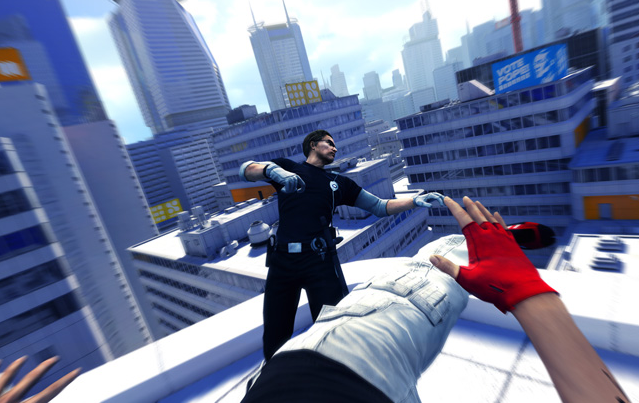 Since there is no way to stretch out the most rewarding instances, two of the game’s other issues become greater obstacles to your potential enjoyment. This is not a long game, probably because you traverse each level so quickly. But if the game as a whole added a few hours, and more gradually ramped up its challenges, the player would have more time to ramp up his mastery. Providing a longer period to gain proficiency, and then a longer stretch to flex those skills, would have overcome that stumbling block. Instead, by the last level or two when you’re really getting the hang of barreling through the environment with abandon, you’re forced into more fights than you were before, and your opportunities to get into a flow are reduced (or at least it seemed that way in my play-through; perhaps someone even better found a skillful route right around all those douchebags in the server room).
Which brings us to the biggest sticking point: the fighting. Wise observers have suggested this game would be better off without enemies entirely, focusing instead on perfecting your runs — as you can do after finishing the game in Time Trial mode. I wouldn’t go that far, as a few of my favorite scenes had me fleeing a hail of bullets and just barely escaping. Reaching an elevator is satisfying, but watching it close just in time to dimple from a shower of gunfire is much cooler. Even better were the times I was chasing another runner and got to see their gymnastics out ahead while trying to follow in their footsteps. These sequences provided a sense of urgency that propelled me through them with more force than my simple desire to run efficiently, and they’re very exciting if you succeed. The trouble spots are when you’re forced to confront rather than evade.
There are slick ways to deal with armed guards just as there are slick ways to climb buildings, like sliding or jumping kicks and disarming combos. Unfortunately they take much more finesse to pull off as smoothly as the your standard acrobatics. It’s as if in the middle of a fantastic line in Skate, you were forced to grind a merry-go-round and ramp off a moving vehicle; the fact that you’re trying to incorporate a dangerous moving target into your ballet of motion makes it nearly impossible to do gracefully on a first attempt. As a result, you’re motivated to avoid them whenever possible, flipping potential stopping points into amazing narrow escapes as you glide past feeling like an unstoppable force. I wouldn’t give up the excitement of that flight from danger to theoretically make the game more digestible — I’m actually a bit wary that the fully-abstract form the future downloadable expansion seems to be taking might rob the game of some of its visceral value. If the fights had been just a bit more fair and forgiving, or they had provided slightly more visible alternate routes, wonky combat would have been a non-issue. But still, the few times there’s no apparent path through Story Mode that doesn’t involve stopping to fight, be prepared for some exasperation.
……….
Although it may sound like I’ve spent too much time picking apart its faults to recommend this game, I’d say the opposite is true. Any work that drives some people crazy whose opinions I respect, while others are crazy about it means at the very least we’re talking about something legitimately interesting. At the end of the day that’s what I want most out of my games, movies, books, bands, or anything else. There’s certainly a place for the sure-fire hits, the popcorn films or pop bands, and Gears of War 2, which I also can’t wait to play even though I picked Mirror’s Edge first for my November play time. But there’s also a place for being challenged. Whether challenging players to master an occasionally exasperating game, or challenging conventions with a genuinely original style of play, I’m glad games like this are being made. Love it or hate it, we all benefit from games like Mirror’s Edge pushing the bounds of possibility forward.
……….
Leave a commentOne other note:
A cadre of other really smart games writers got into a debate about whether this game was being unfairly criticized for its shortcomings, and whether reviewers were downplaying the value of its creative risks. Though I personally loved reading all the different reactions, that seemed more of a debate about the role of criticism than about the game itself, and I resisted the temptation to spend too much time on that here — trying to focus more on what the game did for me and why it was worth putting up with some hitches. Hopefully I succeeded in that, because damn, did I enjoy this game.
listening
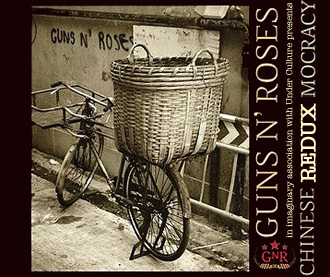 (Re)Producing ‘Chinese Democracy’
I’ve never been a fan of Guns N’ Roses. While I really do love some of the classic riffs and solos, the usual suspects so transparently obvious they don’t require enumeration, I find most of their catalog meandering, boring, and abrasive. In high school, my friend Justin would constantly play Appetite for Destruction, until I finally threw his copy out the window of my Buick and drove over it. Repeatedly.
Perhaps shading my opinion of the band was the irritation I felt towards Axl Rose. During his prime, he toured the world acting like a temperamental child, performing when the whim struck him, abstaining from doing so and creating riots when he didn’t. I despised his attitude, and how disproportionate his ego was relative to his talent.
But as he entered his eccentric Howard Hughes phase (1995 to now), my hatred began to subside, and eventually work its way into muted curiosity. As he labored on Chinese Democracy, added established musicians like Robin Finck and Tommy Stinson to the band, continued to delay releasing any music, and then erratically began clumsy new tours with the reformed Guns N’ Roses, the curiosity became fascination. What the fuck was he doing?
And now, in 2008, we finally have thirteen years of his work, in the form of Chinese Democracy. The storied production is so epic, it’s almost unbelievable. Highlights include a $17 million dollar production budget, Dr. Pepper owing everybody in America a free can of soda once the CD was released, guitarist Buckethead refusing to record parts until they built him a chicken coop within the studio, and Sebastian Bach constantly tossing rumors into the mix, such as Chinese Democracy supposedly being only one of four albums the band has already finished.
It’s no surprise that the final result doesn’t live up to the process of its creation. In fact, it would probably be impossible for any album to do so. But what is surprising is just how bad it is. Well, maybe not that. Maybe a better way of saying it is, it’s how it’s bad that’s surprising.
The songs are schizophrenic. In attempts to be epic and imitate Queen by being constructed of dozens of parts, they instead sound like someone who doesn’t like what they’re hearing switching radio stations. A lot of the time, the band will do something really cool for about 5 seconds, and then literally switch to a completely different musical idea, without warning, during what sounds like the middle of a phrase.
The ADD nature of Chinese Democracy isn’t the only problem. As I listened to it the other night with some friends, one of them pointed out that the solos were “tasteless”. We had been trying to articulate what exactly was wrong with them for about four tracks when he finally came up with that, which I felt was the perfect description. The basic difference is that, with the original Guns N’ Roses lineup, the notes in the solos make musical sense and convey some sort of effect upon the listener; on Chinese Democracy, the notes in the solos make musical sense, but are a bunch of pointless noodling run through cheesy filters that serve only to irritate and confuse the listener.
However, there was one other thing we noticed. Every song had good, or at least interesting, parts. True, they were frequently like meteors, and would effectively show up, give a little wave, and then vanish to be replaced by some generic circa-1995 industrial riff, but they were there. “Oh,” I’d say. “I like this…[part would change] never mind.” One of my friends suggested that those parts should have been expanded, that it was the role of the producer to identify those moments and rein the band in, and that Axl should kill whoever was supposed to fill that role. “Um…I’m pretty sure that he’d have to commit suicide, then,” I noted.
But then I thought about it. The reason this album got made and was the fiasco that it was is because nobody would stand up to Axl. In Geffen’s sycophantic attempts to keep him placated, in the hopes that he would release a magical album that would sell to a target audience largely consisting of people who don’t actually pay for music anymore, they outlaid millions of dollars, wasted tons of talent, and compromised on every possible issue. They were nice to Axl, because they wanted something from him, and because they were scared of him.
I, on the other hand, am not at all scared of him, and should have been hired as the producer of the album. Because a) I think he’s a dick, b) I’m not on his radar, c) I’ve listened to music that came out after the year 1992, and d) Axl usually stays indoors, I think I can mouth off without any consequences from him. So whereas his label will let Axl make his hiring decisions on the basis of the opinion of a strange Southwestern fake-psychic/guru nicknamed “Yoda” (true story), I could have told Axl to stop believing in bullshit, and Yoda to kindly go fuck herself, entirely without consequence. More importantly, I’m not afraid to say to Axl, “You really spent thirteen years on this and thought this was acceptable? Get back to work and let’s do this right.”
But I can’t go back in time and re-record tracks. I can only chop, snip, edit, and recontextualize the existing ones. And that’s exactly what I’ve done. I’ve filtered a dense, 71:24 minute mess into a breezy 7:40 hard rock classic. As mentioned above, the transitions in the original album were pretty jarring, so me switching from musical idea to musical idea without warning or repetition is not really that different from the original result, anyway. In fact, the main difference is that everything you’re about to hear is actually of note, as opposed to being surrounded by a bunch of nonsense.
This is basically Bohemian Democracy, the epic album that Axl should have proudly released, and the one that would have earned him the glowing adulation of his fans and critics. Granted, unlike most albums, it’s only 7:40 long, working out to about 30 seconds per year of Axl’s labor, but I think quality far outweighs quantity. In fact, at a mere 7:40, it’s shorter than the average track on the goofy album. Also worthy of mention is that playing it loud enough can actually transport you back to 1997.
Without further ado, Under Culture is pleased to bring you the world premiere of Chinese Democracy Reproduced: the album that would have been made if anybody had the balls to stand up to sleaze rock’s equivalent of Colonel Kurtz. Enjoy.
[audio:Chinese_Democracy_Reproduced.mp3]Guns ‘n’ Roses – Chinese Democracy (Reproduced)
2 commentsside notes
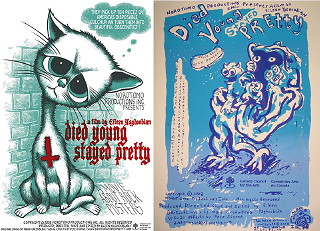 Rock Posters; Tool Toasters; a Maverick Roaster; and Austin, Closer
Occasionally — perhaps inevitably — I’ll end up finding and posting something here solely because I am in love with it and I don’t want to forget about it, never expecting anyone else to come around to realizing how great it is. I suppose this could be one of those times, but I’m willing to risk it because I am smitten with this idea that combines two of my favorite things.
Died Young, Stayed Pretty is an indie documentary by first-time filmmaker Eileen Yaghoobian about contemporary rock poster culture. The people that make them, the ideas that go into them, and the fans who love them — primarily the community at GigPosters.com. As a fan myself, whose apartment walls are adorned almost solely by screen-printed gems from the past ten years, I cannot wait to see this movie. I’ve read interviews at Creativity Online and Ioncinema, I’ve watched the trailer on Youtube (below)… The whole thing gets me bristling with art and music nerd energy. Now, the wait begins.
See, the problem is that this movie, as the poster culture it documents, is a very DIY affair and only playing the festival circuit at the moment. Even still, only in the director’s native Canada. It could be a long while before I get a chance to view this, if I’m lucky, at a one-night-only engagement here in LA; or longer before it makes it onto DVDs available someplace like Netflix. What are the logistics for a small-time website sponsoring a special screening event? Would I have to rent a venue and promote for ticket sales and other costly things? I could also just wait patiently and hope it doesn’t slip my mind by the time an opportunity arises, but that’s far less exciting.
……….
 This item is less newsworthy, but much more amusing. Apparently Maynard Keenan — yes, the one from Tool — is a huge wine fanatic. Maybe his bigger fans already knew this, but I was not aware that in the past few years he’s started his own vineyard in Arizona dubbed Merkin (snicker), created a label called Caduceus complete with a suitably mysterious website (give it a minute to load for the full effect), and is currently wrapping up a short tour of signings in select Whole Foods locations.
That’s right, this Friday the 5th, gentle citizens and tortured goth kids alike can line up in sleepy El Segundo, California to have their wine bottle signed by a master of both freaky prog metal and smooth southern Syrah. What a bizarre and truly wonderful world we live in. Can’t you just see it now?…
[Eclectic crowd gathered at Whole Foods collectively sips wine]
Pampered Housewife: (jubilantly) “This has an earthy aroma, a tart fruitiness reminiscent of spring pomegranate, and a crisp finish. Very refined! I should serve this at the Christmas party!”
Eyelinered, Long Black-Haired Metal Fan: (in somber monotone) “the sanguine hue of this brooding beverage hearkens to the dark recesses of my bloodstained nightmares. i’ll take two bottles please, and would you also sign my platform boots?”
……….
Good to know I wasn’t the absolute last person writing post-election wrap-ups. Of course, it could be that real writers either report news promptly, or take their time to create well-thought-out magazine pieces, and the rest of us, well… we do our best.
The consistently excellent Matt Taibbi refelcts on election night at Rolling Stone, as harshly honest as ever.
But ordinary Americans, alas, would have been perfectly happy to spend the rest of eternity mesmerized by the endless and endlessly condescending I’d Like to Have a Beer With You sideshow, leaving the boring policy stuff to the people who actually pay for the campaigns. Things could have just kept getting dumber and dumber, and no one would have been surprised. There was certainly no trend that suggested our presidential elections were bound to return to being great, sweepingly important contests of ideas. But that’s what happened.
I’m really hoping The Great Derangement turns up under a tree for me at Christmas — I can’t get enough of this guy.
……….
And one last bit of fun. I didn’t write much about it at the time other than some twitter updates, but Under Culture was representing at Austin City Limits this year. Want proof? They’ve recently posted ginormous, zoom-in-able photos from a few of the stages on their site.
If you look reeeeeally closely, you can see my head somewhere in the photo from the Raconteurs set. Did you find it? No, not there, on the left, by the other guy.
It’s called Gigapan technology, and there must be an army of robots involved — possibly the same ones in charge of either Google Earth or the Where’s Waldo? books.
If you didn’t have any luck, here is the zoomed in version from when I did finally find myself. The arrow is pointing to the tiny top corner of my girlfriend’s face, just barely visible even via Gigapan. Maybe they should be investing more in technology that lets the crowd see the stage instead of vice versa?

playing
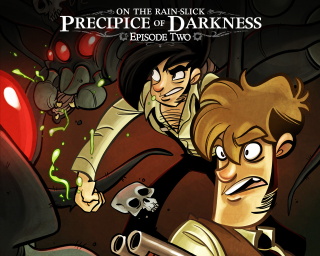 Our Pals at Penny Arcade Get Episodic Right
By the time they’d decided to put out a game of their own, the proprietors of Penny Arcade already felt like old friends to me. Between their regular posts, comics, and occasional podcasts — all of which are refreshingly frank and funny, a mix of comedy and criticism — their sense of humor, as well as their sense of what makes a good game, were well apparent. I’ve agreed with them more often than not, like a slightly nerdier pal who knows his shit and good-naturedly advises you on games while cracking jokes that reference role-playing.
Maybe because of that sense of relationship to the creators, I was willing to forgive the game’s few faults. While playing the latest installment on Live Arcade, some isolated bugs did get in the way of pure enjoyment, so I feel obligated to politely get them out of the way. For example, a brain-shaped puzzle section midway through the game froze as I was almost finished, forcing me to start again. During the two-part final boss fight, I easily passed the first phase and couldn’t quite figure out the trick to phase two on my initial attempt. After failing, the fight wouldn’t re-initiate, leaving me stuck standing and staring at his menacing gyrations. Again, I had to reload. Design-wise I was only really frustrated once. I had to traverse the world several times looking for a bouquet’s worth of flowers to please an insufferable old woman who stood between me and the rest of a level, because the ones I brought her the first time were the wrong color. Choosy wench.
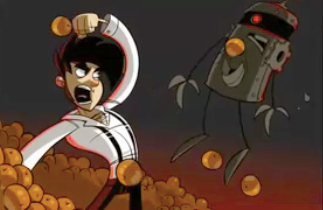
But I’m much more willing to overlook these minor inconveniences a) because the rest of the game is so enjoyable, and b) because I know the team behind it cares enough to listen to complaints like these and try to make improvements. And since it’s episodic, they’ll put them into practice by the next release. In fact, the second episode is already an improvement over the first. The battles are more intricate and the levels are more varied. They made this installment longer, and added more of the entertaining animated sequences — of which I particularly enjoyed the robotic mayhem, and Tycho’s facial expression leading into the final battle. I even thought the jokes were better. There’s a bit about the use of a file in a jail break that’s particularly great comedy. This is one of the only games in my collection other than Psychonauts and a few segments of GTA’s talk radio that made me laugh consistently, so it’s in good company. Since more often in games the laughs come at the expense of the dialog, intentionally funny lines deserve honest praise.
……….
 The most appealing things about this game, though, have less to do with the finer details of the content itself than with the form it takes as a whole. For starters, this has to be the best licensed game I’ve ever played — admittedly a short list, since most licensed games are so universally panned they don’t even get the benefit of a trial. Flying in the face of cheap cash-ins, Penny Arcade Adventures effectively retains the personality of the source material, but doesn’t try to recreate an existing experience in game form. Instead, they built a game around the property that allows them to highlight their strengths, making a light-hearted RPG with unique visuals, quirky characters, clever storytelling, and genuinely funny writing. Sure, that’s thanks mostly to their perfect storm of circumstances, having heavy involvement in the process as well as a deep understanding of games, but they still deserve credit for making it work.
Still, the single most attractive thing about playing On The Rain-Slick Precipice of Darkness, to me, is how they’ve nailed the sweet spot of episodic content delivery. The timing is great; they don’t pass the window of even qualifying as episodic like Half-Life, nor do they break up a single game into chunks just to parcel it out over time. Each of the two installments have felt like concise, self-contained stories that can be played over a week at an hour a night, or over a weekend if you dedicate a couple of full afternoons. It’s a combination of high involvement and low investment that perfectly suits an adult gamer’s schedule. High involvement in that it’s by no means ‘casual’ — in the sense most people mean when referring to simple, free, Flash puzzle games — with a full suite of character leveling, strategic combat, actual puzzle-solving, collectibles, and a solid narrative. But low investment in that you know it’s only a handful of hours’ time, doesn’t involve endlessly complicated decision-making, and you can actually finish it in a weekend without becoming dead to the world.
Contrast their delivery method with a game like Fallout 3, which I’ve also been playing and took a break from to download Penny Arcade. In the former, there are dozens of what could be called ‘episodes’, with each side mission telling its own self-contained story, all taking place in the same world. But since each of those could be happening concurrently, the amount of options at any time gets overwhelming and almost paralyzing. I look at the Fallout map and see so much blank space left to explore, there’s literally no end in sight. With episodic delivery, I know that I’m committed for a digestible chunk of time, and that by the end of that span I’ll have been told a story and felt like I’ve accomplished something. With the more difficult and expansive open-world game, I could spend a whole weekend playing, getting killed fairly regularly because I’m not leveled up enough, and only progress from 20% to 24% complete while wondering what the fuck I’m doing with my life.
I’m not saying Fallout isn’t satisfying in other ways. Sometimes I do want a sprawling epic, and there’s room in my library for both. It’s just a shame that so few are providing that low-investment experience without also being low-involvement (I’m looking at you, twin-stick shooters and falling-jewel-puzzle clones). The funny (or troubling) thing is, the amount of play time built into this $15 game isn’t that much less than some full-priced games, clocking in around 6 hours or so at my guess. It’s certainly a good value for the price. But it feels like less of a commitment, with the added benefits that only come from episodic delivery. For example, they can use cliffhangers, a device under-utilized in games, which full-sized titles get skewered for since resolution could take over a year. And instead of buying a giant RPG, playing half-way through and moving on because it’s grown tiresome, each chapter is a fresh start and a chance to get re-charmed by the game all over again. Really, I’m shocked there aren’t heaps of people doing this instead of a select few.
If it has to be one — on Xbox anyway, since Mac-using non-Wii owners are missing out on Sam & Max or Strongbad games — I’m glad it’s the team at Penny Arcade, and that they’ve put so much thought into doing it right. Dropping into their strange and supernatural steampunk world every few months has been a welcome change of pace from the serious and strenuous larger-scale games, and I love the fact that I won’t have to wait much longer to do it again.
Leave a commentwatching
 Casting Blood Meridian: or The Evening Redness in the West
We live in a cautious era. As the capital required to finance a motion picture has skyrocketed, the age of the auteur has vanished, and movies are now made by committee. Creative and original visions languish on shelves, while movie adaptations of works from other disciplines, like comics or TV shows or books, are quickly rushed through the production process. Because of this, appealing to a franchise’s pre-existing fan base has become of primary importance to many executives, and vocal fanboys on the Internet have gained near unimaginable power.
Blood Meridian is the revisionist Western that Cormac McCarthy wrote after winning a MacArthur Genius Grant. Heralded as one of the best novels of the 20th century, the long and storied production of a film adaptation of the work has been accelerated by the recent success of another McCarthy adaptation, No Country For Old Men. The subject matter of Blood Meridian, this masterpiece of historical fiction, is undeniably brutal: it details the atrocities of the Glanton Gang as they massacre Native Americans along the U.S. and Mexico borderlands for scalp money. Descriptions of their looting, raping, pillaging, and violence are stomach-churning, and it will require a talented cast and crew, capable of the expressing the most subtle degrees of nuance, to truly present the story in a way that accurately captures the correct tone.
To that extent, it is good news that Todd Field has recently taken over as the main creative force for the project, in the roles of both writer and director. Field is perhaps best known as the writer and director of In The Bedroom, the 2001 drama that received multiple Academy Award nominations (including two for Field) for its sensitive portrayal of a family pushed to the limits through tragedy; it is a stunning meditation on justice. Field has what it takes to bring Blood Meridian to life: now all we need are the people acting in front of the camera to be capable of matching Field’s discipline and talent.
Having read and loved Blood Meridian, and having followed its cinematic adaptation with some degree of fervor, I have spent a lot of time contemplating the cast for this project. Who has what it takes to fill these amazing roles? After much time and effort, I believe that I have assembled the ideal team to handle the strenuous psychological demands and tolls that a project like this will inflict upon them. If any of you know the casting director of Blood Meridian, please share this with them, entirely free of charge; seeing my cast bring this story to the silver screen is the highest reward I can think of. Without further ado, I submit to you the objectively perfect cast for Blood Meridian:
Judge Holden: Eddie Murphy (Caucasian makeup; bicep enhancement prosthetics; shoe lifts; skin makeup that appears to remove his eyebrows, eyelashes, head hair, and even ear hair; walks on stilts so as to reach the appropriate height of 7 feet and 14 inches)
The Kid: Eddie Murphy (Caucasian makeup; stubble wig; bicep enhancement prosthetics; saturation of Oil of Olay helping him to reverse his age until he looks approximately 16 years old)
Glanton: Eddie Murphy (Caucasian makeup; beard wig; bicep enhancement prosthetics; pants with upside-down U-shaped frame so that he always walks bow-legged)
Reverend Green: Eddie Murphy (Caucasian makeup; moustache wig; cassock)
Norbit: Eddie Murphy (Afro wig; glasses; bicep reduction prosthetics)
Toadvine: Eddie Murphy (Caucasian makeup; black and ropy locks wig; camera trick used to make his head look narrower; H and T branding on forehead prosthetic; ear removal via green screen)
Naked Gileño Infant Swung By Heels and Smashed Against Stones: Marlon Wayans (Gileño makeup; hat with propeller on top; use the same special effect they used in Little Man, except now put his head on top of a Gileño baby’s body)
White John Jackson: Eddie Murphy (Caucasian makeup; prosthetic snarl; stubble wig)
Black John Jackson: Jack Johnson (African-American makeup; prosthetic snarl; stubble wig)
Small Goat That Gets Shot: Eddie Murphy (Prosthetic horns; prosthetic fur; prosthetic legs where arms should be; squib that explodes when he’s shot; prosthetic tail; “Vertigo”-type camera effect where they shoot him from far away so that you make him look like a small goat, as opposed to one of normal size; character speaks with voice somewhat inspired by that of “Donkey” in Shrek)
The Mennonite: Eddie Murphy (Caucasian makeup; bicep reduction prosthetic; really long beard wig; calm demeanor prosthetic)
Comanche #3: Eddie Murphy (Native American makeup; bicep enhancement prosthetic; quadricep enhancement prosthetic; long black hair wig; war paint makeup)
Enormous Whore: Eddie Murphy
7 commentsside notes
 RS Remembering Wallace, Aronofsky Wrestling Rourke, Sony Snubbing Netflix
Something sad happened last month while I wasn’t posting much here, and I won’t bother with much comment on the matter itself since it’s no longer news, and my words would be inadequate.
For an outstanding look back at the life and work of an amazing talent, I urge you to read the Rolling Stone piece, The Lost Years and Last Days of David Foster Wallace.
As an article, it deals less with the sordid details than Wallace’s lifelong struggle with himself and what it means to be a ‘genius’. The intimate friends and family accounts are particularly eye-opening, as he’d always been a mysterious figure who produced strange, brilliant work. Reading about the difficulties he faced makes his achievements even more humbling.
……….
But no more being somber, let’s get nerdy. Two articles I read in short succession over at Film School Rejects set off an interesting thought.
The first was a take-down of a ‘most overrated directors’ list posted to Spike.
The original numbered off the easy suspects you’d probably expect (Smith, Tarantino, Burton, Shyamyalyaman, etc), but the FSR writer correctly blasted the former for mistaking ‘overrated’ for ‘entirely aptly rated’, and picking on a bunch of directors who either make great movies for very specific audiences, or have floundered and rightfully lost respect. None of the mis-steps by those listed were blindly adored, and discounting their achievements because of later flops is a little cheap. Either way, it’s a good debate topic and his response brings up some much better candidates for discussion (listing Welles, Hitchcock, Kubrick et al, to which I’d add Michael Bay, Ridley Scott, maybe Michel Gondry just for fun). Any film buff could go on for hours on this topic.
The next story that grabbed my attention was the recently released trailer for The Wrestler.
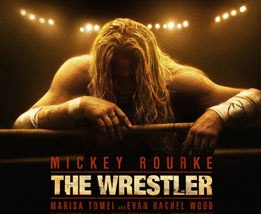 In a few short minutes you can imagine yourself both cheering and crying at this movie, despite the fact that it could easily be renamed White Trash Heartbreak without totally missing the mark. If anyone had asked me before this year if I could see myself looking forward to a movie about a washed up wrestler, I would have laughed at them, but now here I am marking my calendar for the January release.
Rourke will get a lot of the credit for this film, and deservedly so by the look of it. But the previous article really made me think about how Aronofsky stands up as a director. He can’t be called overrated, probably because he’s flown pretty under the radar over the course of his handful of movies. But really looking at his body of work, he might be one of the most interesting people making movies. Going from paranoid math/Kabbalah noir, to intense addiction tragedy, to epic time-traveling sci-fi love story, to triumph of the athlete’s heart — you certainly can’t fault him for being a one trick pony. Can’t wait to catch this one.
……….
 This week also saw the debut of the new Xbox dashboard, with the excellent added feature of Netflix streaming for those of us who are game and movie nerds. I’ve only played around with it briefly to sample video quality and make sure it was set up for when I get the chance to really dive in later — at which point we may have further thoughts on the upgraded service here.
The excitement was quickly tainted thanks to rivals at Sony Pictures, who conveniently pulled their content this week.
On the one hand, this isn’t surprising or even unreasonable in business terms, and some statements indicate it may only be temporary while ‘licensing agreements’ are dealt with. On the other hand, the timing is a little suspect to suggest these are just discussions naturally taking place while big corporations negotiate digital distribution. It comes off more as one kid getting angry when another kid gets a bigger slice of the birthday cake. Let’s hope the parties involved can be a bit more adult so we, too, can enjoy an Evening with Kevin Smith, Part 2 in the near future.
Leave a comment Subscribe to Posts
 Subscribe to Podcasts
 Become a Facebook Fan